
Executive Summary
This focused analysis compares material efficiency and cost structures between the APSX-LSR desktop system and industrial LSR injection molding machines (ENGEL e-motion and ARBURG Allrounder Golden Electric). The study reveals significant advantages for the APSX-LSR system in material waste reduction and cost-effectiveness for educational and small-batch applications.
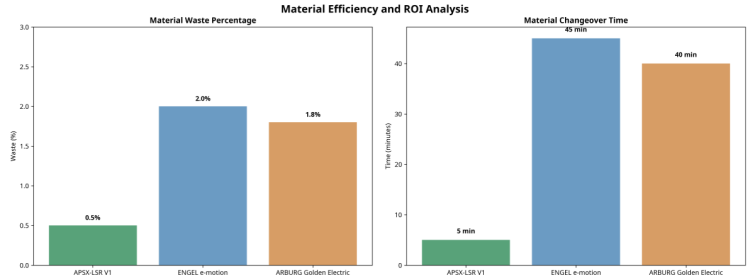
Key Findings: - Material Waste: APSX-LSR achieves 0.5% waste vs 1.8-2.0% for industrial systems - Initial Investment: APSX-LSR costs $14,950 vs $200,000-$400,000+ for industrial systems - Material Changeover: APSX-LSR requires <5 minutes vs 30-60 minutes for industrial systems.
1. Introduction
Liquid silicone rubber (LSR) injection molding presents unique material efficiency challenges due to the inability to regrind and reuse LSR materials, unlike thermoplastics.
Every gram of waste represents permanent material loss, making efficiency optimization critical for both economic and environmental reasons.
The comparison focuses on three distinct approaches: the APSX-LSR desktop system with its cartridge-based material handling, and industrial systems from ENGEL and ARBURG that utilize traditional external dosing systems.
2. Material Waste Analysis
2.1 Waste Sources and Quantification
Material waste in LSR injection molding occurs through several mechanisms, each affected differently by machine design and operational procedures. Understanding these waste sources is essential for accurate efficiency comparison.
APSX-LSR V1 | ENGEL e-motion | ARBURG Golden Electric | |
Setup Waste | 0.1% | 0.5% | 0.4% |
Changeover Waste | 0.1% | 1.2% | 1.1% |
Process Waste | 0.2% | 0.2% | 0.2% |
Purging Waste | 0.1% | 0.1% | 0.1% |
Total Material Waste | 0.5% | 2.0% | 1.8% |
The APSX-LSR system's cartridge-based approach eliminates most changeover waste by using pre-filled, sealed cartridges that require no purging between material changes. Traditional industrial systems require extensive line purging during material changeover, resulting in significant waste that can exceed the total material usage of small-batch applications.
2.2 Changeover Efficiency Comparison
Material changeover represents the most significant source of waste differences between systems.
Changeover Factor | APSX-LSR V1 | Industrial Systems |
Changeover Time | <5 minutes | 30-60 minutes |
Material Required for Purging | 0g | 200-500g |
Labor Hours per Changeover | 0.1 hours | 1-2 hours |
Downtime Cost per Changeover | $15-25 | $150-400 |
The cartridge system's sealed design enables material changes without exposing the material to contamination or requiring system purging. This approach provides particular advantages for research applications where multiple materials may be evaluated in a single session, or for small-batch production requiring frequent material changes.
Figure 1: Material efficiency analysis showing waste percentages, changeover times.
3. Cost Structure Analysis
Initial Investment Comparison
The initial investment requirements represent the most significant cost differentiator between desktop and industrial LSR injection molding systems.
Cost Category | APSX-LSR V1 | ENGEL e-motion | ARBURG Golden Electric |
Base Machine Cost | $14,950 | $180,000- $300,000 | $200,000-$350,000 |
Installation & Setup | $500 | $20,000-$40,000 | $20,000-$40,000 |
Auxiliary Equipment | $0 | $30,000-$60,000 | $30,000-$60,000 |
Facility Modifications | $0 | $15,000-$35,000 | $15,000-$35,000 |
Training & Commissioning | $500 | $8,000-$15,000 | $8,000-$15,000 |
Total Initial Investment | $15,950 | $253,000- $450,000 | $273,000-$500,000 |
The 15-30x difference in initial investment fundamentally changes the economic equation for LSR injection molding adoption. Educational institutions and small manufacturers can access LSR capabilities with the APSX-LSR system at investment levels that would represent a small fraction of industrial system costs.
4. Application-Specific Cost Analysis
4.1 Educational Institution Economics
Educational applications present unique economic considerations where learning value and accessibility often outweigh pure production efficiency. The cost analysis for educational institutions reveals compelling advantages for the APSX-LSR system.
Educational Cost Factors:
APSX-LSR V1 | Industrial Systems | |
Budget Compatibility | Excellent | Poor |
Cost per Student Hour | $15-25 | $75-150 |
Annual Utilization | 500-1000 hours | 200-400 hours |
Learning ROI | Very High | High (if accessible) |
The APSX-LSR system's low cost enables educational institutions to provide hands-on LSR injection molding experience at a fraction of the cost of industrial alternatives. The simplified operation also reduces supervision requirements and enables broader student access.
4.2 Research and Development Economics
Research applications emphasize flexibility and material exploration over high-volume production efficiency. The economic analysis for R&D applications reveals significant advantages for the APSX-LSR system in most scenarios.
R&D Cost Considerations:
Research Factor | APSX-LSR V1 | Industrial Systems |
Material Exploration Cost | Low | High |
Prototype Development Cost | $50-150 per iteration | $200-500 per iteration |
Research Timeline Impact | Minimal | Significant |
Equipment Accessibility | High | Limited |
The APSX-LSR system's rapid changeover capabilities and low material waste make it particularly cost-effective for research applications requiring evaluation of multiple materials or frequent design iterations.
4.3 Small-Batch Manufacturing Economics
Small-batch manufacturing represents a growing market segment where the APSX-LSR system's economic model provides significant advantages.
The cost advantage for small-batch production makes the APSX-LSR system viable for applications that would be uneconomical with industrial equipment.
5. Conclusions and Recommendations
5.1 Key Economic Findings
The APSX-LSR system provides compelling economic advantages for educational, research, and small-batch applications through superior material efficiency and dramatically lower cost structures.
Primary Economic Conclusions:
Material Efficiency: The APSX-LSR system achieves 99.5% material utilization compared to 98.0-98.2% for industrial systems, with advantages increasing as changeover frequency rises.
Cost Structure: The 15-30x difference in initial investment and 1-2x difference in operating costs create fundamentally different economic models favoring the APSX-LSR system for low-volume applications.
5.2 Application-Specific Recommendations
Educational Institutions: The APSX-LSR system is strongly recommended for educational applications due to its cost accessibility, operational simplicity, and material efficiency advantages. The system enables hands-on LSR experience at investment levels compatible with educational budgets.
Research and Development: The APSX-LSR system is recommended for most research applications, particularly those involving material exploration, prototype development, and concept validation. The rapid changeover capabilities and low material waste make it ideal for research requiring multiple materials or frequent iterations.
Small-Batch Manufacturing: Organizations producing fewer than 25,000 parts annually should strongly consider the APSX-LSR system. The economic advantages are substantial for small-batch applications, with cost savings of 60-80% typical.
5.3 Strategic Considerations
Technology selection should consider long-term strategic objectives beyond immediate cost considerations. The APSX-LSR system's accessibility enables organizations to develop LSR capabilities and expertise that may support future growth into higher volume applications using industrial systems.
Organizations should also consider the educational and research value of accessible LSR technology. The ability to provide hands-on experience with advanced manufacturing processes can have long-term benefits that extend beyond direct economic returns.
The emergence of desktop LSR injection molding technology represents a significant development in manufacturing accessibility. Organizations should evaluate their specific requirements carefully, but the compelling economic advantages of the APSX-LSR system for appropriate applications make it a transformative technology for educational institutions, research facilities, and small manufacturers seeking to access advanced LSR capabilities.